 Houston Terrazzo Restoration
Terrazzo Floor Restoration in Houston
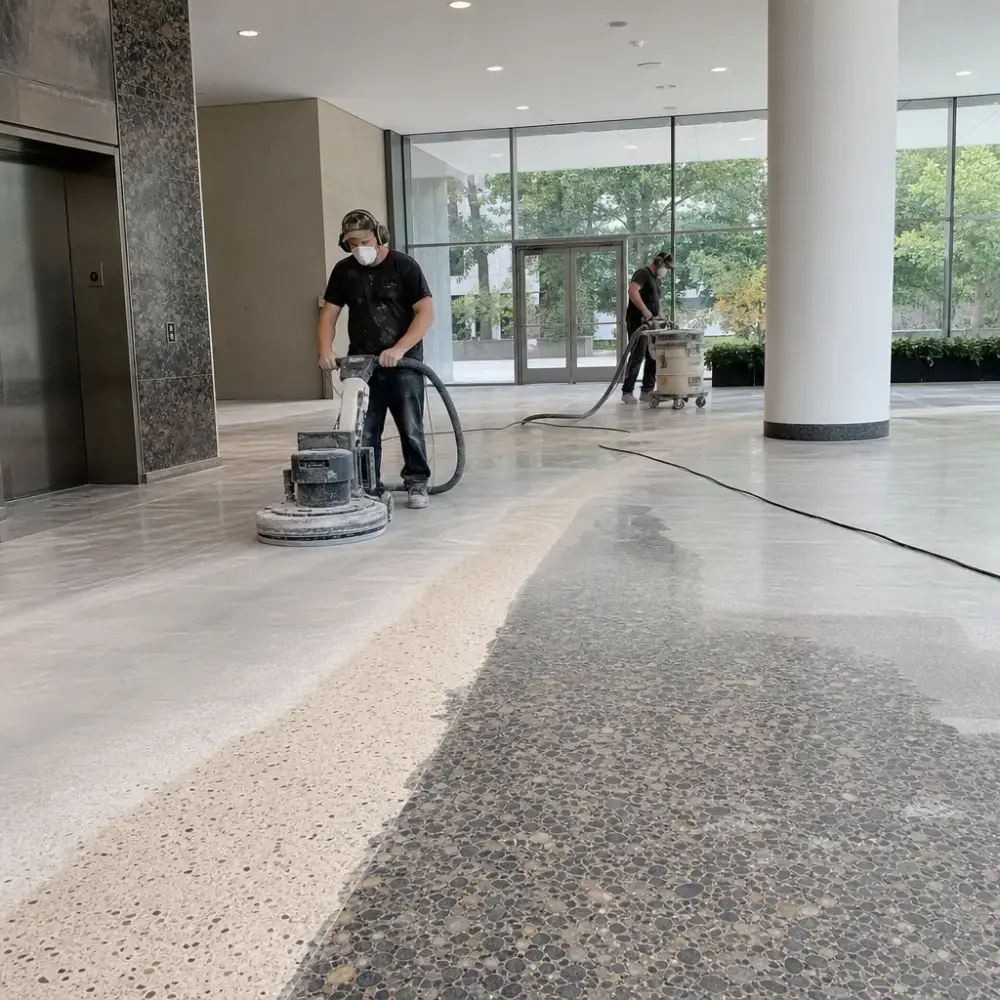
Full terrazzo restoration in Houston costs $4 to $8 per square foot for the grinding and polishing, plus $1 to $3 per square foot to take carpet and glue off or $3 to $6 for tile and thinset, plus $75 to $300 per patch for cracks and holes. Most houses with 1,000 to 1,500 square feet of terrazzo come in between $4,000 and $12,000 for the grind and polish before removal and repairs. It is the whole job: the floor goes from covered and tired to ground, repaired, polished, and sealed.
This is the service for a floor someone else gave up on. The terrazzo in a 1950s or 1960s Houston house was poured and ground on site the year the house went up, covered when tastes changed, and has been carrying carpet, glue, and furniture ever since. Underneath all of it the stone is usually fine.
Step 1: getting the floor back
Carpet, pad, and tack strip come up first, then whatever adhesive is under them. Tile comes up with its thinset. We go slowly around divider strips and at door thresholds, because those are the edges that chip. If old resilient tile or black adhesive turns up, it gets tested for asbestos before anyone grinds it: the Consumer Product Safety Commission lists asbestos and asphalt floor tiles and the adhesives used for floor tile among the materials that may contain it. The details of this stage are on the removal page.
Step 2: looking at what you have
Once the floor is open, we map it. What size are the chips and what color is the matrix? Are the divider strips brass or zinc, and are any missing? Where are the cracks, which are old, and does any of them have one side higher than the other? Are there hollow spots that sound different when tapped? Is there an old coating that will gum up the diamonds? Is the slab damp?
The NTMA’s restoration guide calls for exactly this kind of walk-through, with owner and contractor deciding together which cracks get no action, which get repaired, and which sections need replacing, and it warns that conditions may have to be re-evaluated once substrates are uncovered. That is why a quote on a covered floor is a range, and why the number is confirmed once the floor is open.
Step 3: repairs before grinding
Holes and cracks are filled before the main grind so that the patch is ground flush with the floor around it. The NTMA guide specifies cleaning the crack of loose material and old sealer, filling it with a matching resin, and adding aggregate once the crack is wider than a quarter inch. Old plumbing trenches and the footprints of removed walls get the same treatment on a larger scale, with matched chips set into a tinted matrix. Missing divider strips are replaced in the same metal. Grout and patches cure before final grinding; NTMA guidance is at least 12 hours.
Most Houston floors also carry a ring of tack-strip nail holes along every wall that had carpet. Those are filled by the room. More on all of it at crack and hole repair.
Step 4: grinding and honing
Planetary grinders with metal-bond diamonds take the first passes. Their job is to make the floor flat, cut through adhesive and coatings, and remove the scratched, stained top layer. Then resin-bond diamonds take over, stepping up through finer grits until the surface closes and the stone starts to reflect light. A matte or satin finish stops around 400 grit. A gloss finish keeps going.
Dust control is part of this step, not an afterthought. Grinding cement makes respirable silica, and OSHA’s construction silica standard lists, for floor grinders, a machine with water fed continuously to the cutting surface and, indoors, HEPA vacuuming of loose dust between passes. That is the method in an occupied Houston house. The grinding and polishing page has the grit-by-grit detail.
Step 5: sealing
A restored residential floor gets a penetrating sealer, not a film. The NTMA’s sealer guide describes honing combined with a silicate-based penetrating sealer as a densifying treatment that reduces porosity and helps the floor repel stains, with no sacrificial coating on top. In Houston’s humidity that matters: a film over a slab that is still breathing moisture can cloud and peel, and a penetrating treatment does not trap it. You leave with care instructions, and they are short. See sealing and maintenance.
What it costs, line by line
| Line | Typical Houston range |
|---|---|
| Grind and polish | $4 to $8 per sq ft |
| Carpet, pad, and glue removal | $1 to $3 per sq ft |
| Tile and thinset removal | $3 to $6 per sq ft |
| Crack or hole patch | $75 to $300 each |
| Stain or rust treatment | $150 to $600 per area |
| Minimum, one room or repair-only | $750 to $1,200 |
The pricing page explains what pushes each line up or down and walks through three worked examples.
Houston floors have a few extra wrinkles
Clay under the slab. The coastal prairie soils around Houston are clay-heavy. The USDA’s official description of Lake Charles clay, an extensive soil in Southeast Texas between the Colorado and Trinity rivers, records 45 to 60 percent clay with dry-season cracks up to 2 inches wide. Slabs on that kind of soil flex with wet and dry years, and a thin terrazzo topping cracks along with the concrete. Old cracks fill well. A crack that is still moving is a foundation question first, and we will say so.
Floods. Many restorations here start in a house that has already been gutted. FEMA’s Technical Bulletin 2 classes terrazzo as a flood damage-resistant flooring material, so it usually stays when the carpet goes. Those jobs skip removal but need a moisture test before sealing. The flood-damaged terrazzo page covers the sequence.
Remodels. Houston’s mid-century houses have been added onto, opened up, and re-plumbed. Each of those leaves a scar in the floor: a strip of concrete where a wall stood, a patch where a drain moved, a doorway cut through. Those scars are the most visible repairs on any job, and the most important part of the quote to discuss before work starts.
What to send for a quote
A photo of each room from the doorway, a close-up of the worst spot, a corner with the carpet folded back so we can see the chips, and the rough square footage. If you know the year the house was built and whether it has flooded, include that. If you want a number before you send anything, the restoration cost calculator builds a range from the same price list.
Frequently Asked Questions
What is included in a full terrazzo restoration?
Everything from the covering down to the seal: carpet, tile, and adhesive removal, repairs to holes and cracks with matched chips, metal-bond grinding to flatten the floor and strip the worn surface, resin-bond honing and polishing to the finish you pick, and a penetrating sealer. The grind and polish is $4 to $8 per square foot, with removal and repairs priced as their own lines.
How much does it cost to restore terrazzo in a Houston house?
A house with 1,000 to 1,500 square feet of terrazzo usually comes in between $4,000 and $12,000 for the grind and polish. Removal adds $1 to $3 per square foot under carpet or $3 to $6 under tile, and each patch is $75 to $300. A clean exposed floor sits low in the range; stacked glue, coatings, and high gloss push it up.
Can a floor that has been under carpet for 50 years still be restored?
Yes, and carpet is one of the kinder things to have on top of terrazzo. The adhesive and tack strips leave glue, rust rings, and nail holes, but those are surface problems that the first grinding passes and a round of patching take care of. The NTMA notes that even decades later minor damage can be repaired and floors re-polished to their original luster.
Will the restored floor look new?
It will look like terrazzo that has been well kept, which is better than new to most owners of mid-century houses. Patches are matched by eye and are visible if you kneel next to them. Deep stains may lighten rather than disappear. We show you a sample patch before the room is finished, and we mark the stains we expect to stay.
More terrazzo services
- Terrazzo Grinding and Polishing in Houston
- Terrazzo Crack and Hole Repair in Houston
- Carpet, Tile, and Glue Removal Over Terrazzo in Houston
- Terrazzo Stain and Rust Removal in Houston
- Terrazzo Sealing and Maintenance in Houston
- Commercial Terrazzo Restoration in Houston
- Flood-Damaged Terrazzo Restoration in Houston