 Houston Terrazzo Restoration
Terrazzo Crack and Hole Repair in Houston
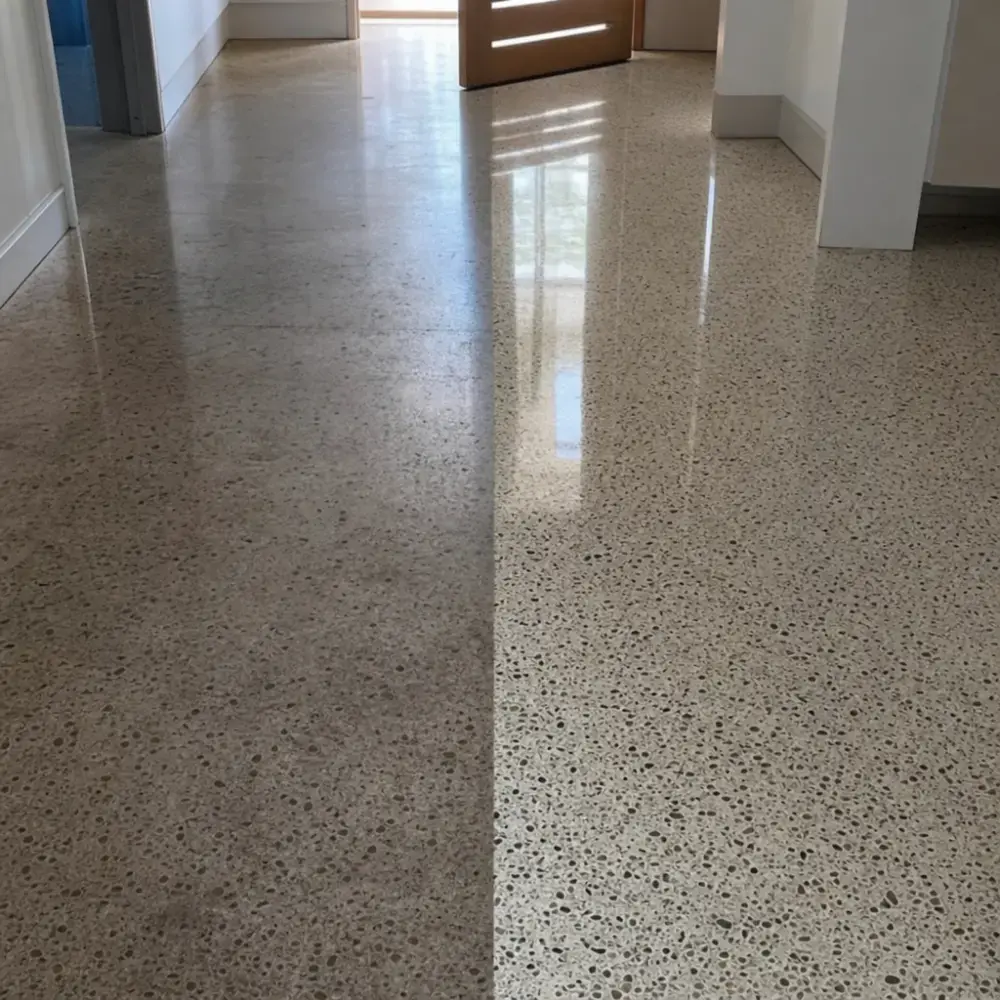
Terrazzo crack and hole repair in Houston costs $75 to $300 per patch. Cracks are cleaned out and filled with matching resin, with marble chips in the fill once the crack is wider than a quarter inch; holes and trenches are filled with matched chips in a tinted matrix; then everything is ground flush with the floor around it. The real question on a crack is not how long it is. It is whether the slab under it has stopped moving.
Common terrazzo repairs on Houston floors
| What you see | Usual cause | Fix and typical cost |
|---|---|---|
| Hairline crack between strips | Shrinkage or slight slab flex | Cleaned and filled with matching resin, $75 to $150 |
| Crack wider than a quarter inch | Older slab movement | Filled with resin and matched aggregate, $150 to $300 |
| Crack with a lip you can feel | Slab moved under the topping | Slab checked first, then cut back and replaced |
| Concrete strip across the room | Plumbing or slab-leak repair | Cut back, refilled with matched chips, top of the range |
| Strip of bare concrete at an old wall line | Wall removed in a remodel | Filled with chips and matrix, priced by length |
| Ring of small holes at every wall | Carpet tack strip nails | Grouted during grinding, priced by the room |
| Missing or bent divider strip | Damage or an old repair | Strip reset in matching metal with the patch |
Every number comes from the pricing page.
Check this before you ask for a price
- Feel it. Run a fingernail across the crack. If both sides are level, the crack is in the topping and the slab has not shifted. A lip means one side of the slab dropped or rose.
- Measure it. The NTMA’s restoration guide defines a hairline crack as less than 1/32 inch and calls for aggregate in the fill once a crack is wider than a quarter inch. A credit card edge is about 1/32 inch.
- Follow it. Cracks that start at an outside corner, run toward a doorway, or follow the line of an interior wall are tracking the slab. Short cracks between two divider strips are usually shrinkage.
- Date it. Did it appear after a dry summer or a wet winter? Did doors in that room start sticking at the same time? A crack that has changed recently is moving.
- Check for water. A crack that stays dark after mopping, or a patch of floor that feels damp, can mean a leak under the slab. That comes before any floor work.
Why Houston slabs crack the topping
A monolithic terrazzo floor is a cement topping, nominally half an inch thick, bonded straight to the slab. The NTMA describes it as dependent on the quality of the concrete slab for flatness and crack prevention. In other words, it cannot hide what the slab does.
What Houston slabs do is ride clay. The city’s own geology, as summarized in its Wikipedia entry, is unconsolidated clays, clay shales, and poorly cemented sands, with low-permeability clay-silt prairie soils at the surface. The USDA’s official series description for Lake Charles clay, an extensive Southeast Texas soil formed on the Beaumont Formation, records 45 to 60 percent clay, smectitic mineralogy, and cracks 1/2 to 2 inches wide at the surface in dry periods that stay open 60 to 90 days in most years. Smectite clays are the kind that swell and shrink. A slab on that soil lifts a little in wet years and settles a little in droughts.
Houston also has more than 150 active faults, including the Long Point and Eureka Heights fault system that runs through the center of the city, though they creep slowly rather than slipping in earthquakes. And where groundwater was pumped for decades, parts of the region southeast of the city have subsided. None of that means a given crack is caused by a fault. It means a Houston floor has more reasons to move than most.
How a crack repair is done properly
The NTMA’s technical director, Gary French, puts the first step simply: figure out why the crack happened, because if you patch it without knowing the cause, it will probably come back. The questions he lists are whether the slab is settling or shrinking, whether the floor is heaving, whether temperature swings are moving it, and whether the crack lines up with something structural.
Then:
- Decide the treatment. The NTMA guide has owner and contractor walk the floor and mark each crack as no action, repair, or replace.
- Test for movement. A crack can be cleaned and grouted with epoxy; if it reopens, something is still moving.
- Repair. Stable cracks are cleaned of dirt and old sealer, filled with matching resin, and given aggregate if wider than a quarter inch.
- Replace where needed. A badly broken section is cut out, opened up at least a foot on each side of the crack according to the NTMA, and replaced. If the replacement does not end at a divider strip or architectural break, the NTMA guide calls for a saw-tooth joining edge rather than a straight line, so the patch does not read as a rectangle.
- Cure and grind. Patches cure, then get ground and polished flush with the floor.
The matching problem, honestly
Your floor was poured with chips from a quarry decades ago. The NTMA warns that on a 50-year-old floor you will not find the same aggregate, because the vein in the source changes over time if the source exists at all. We match by chip size, color, and matrix tint, and we show you a sample before doing the room. When the match is not good enough, replacing a whole panel between strips in a complementary color is often the better-looking answer.
When a floor crack is not our job yet
A crack with a lip that is growing, doors that have started to bind, cracks in the brick outside that line up with the one in the floor: those point at the foundation. A patch over a moving slab will crack again. We will tell you that up front, and the floor can be repaired once the slab is stable.
Want a number now? The repair-only estimator prices patches, stain work, and sealing together. For the whole floor, use the restoration calculator, and for more on reading cracks, see cracks from slab movement.
Frequently Asked Questions
How much does it cost to fix a crack in terrazzo?
$75 to $300 per patch. A short hairline crack cleaned and filled with matching resin is at the low end. A long crack that has to be opened up, filled with matched chips in a tinted matrix, and ground flush is at the high end. If the room is also being ground and polished, the patch is done first and ground with the rest of the floor.
Why do Houston terrazzo floors crack so much?
Because the slab under them moves. Houston sits on clay-rich coastal prairie soil that swells when wet and shrinks when dry; the USDA's description of Lake Charles clay records dry-season cracks half an inch to 2 inches wide. A cement terrazzo topping bonded to the slab follows it. Most cracks are old and stable. A few are still moving, and those need a foundation look before a floor repair.
Can you patch the trench where a plumber cut through my terrazzo?
Yes. Slab leaks and re-plumbing jobs often leave a concrete strip through the middle of a terrazzo floor. The concrete is cut back below the surface, the trench is filled with matched marble chips in a tinted matrix, cured, and ground flush. It is the most visible kind of repair, so we make a sample first and discuss chip size and matrix color with you.
Will the patch be invisible?
From standing height it usually blends; on your knees you will see it. The NTMA says color matching existing aggregate may not be exact because marble is a mined product that alters over time. When a match is impossible, its technical director suggests replacing a whole panel between divider strips in a complementary color, so the eye reads it as design.
What about all the little nail holes around the walls?
Those are tack-strip holes, a ring of them along every wall that had carpet, often with a rust ring around each one. They are filled with matching grout during the grinding and priced by the room rather than by the hole, because a single bedroom can have a couple of hundred.
More terrazzo services
- Terrazzo Floor Restoration in Houston
- Terrazzo Grinding and Polishing in Houston
- Carpet, Tile, and Glue Removal Over Terrazzo in Houston
- Terrazzo Stain and Rust Removal in Houston
- Terrazzo Sealing and Maintenance in Houston
- Commercial Terrazzo Restoration in Houston
- Flood-Damaged Terrazzo Restoration in Houston