 Houston Terrazzo Restoration
Terrazzo Grinding and Polishing in Houston
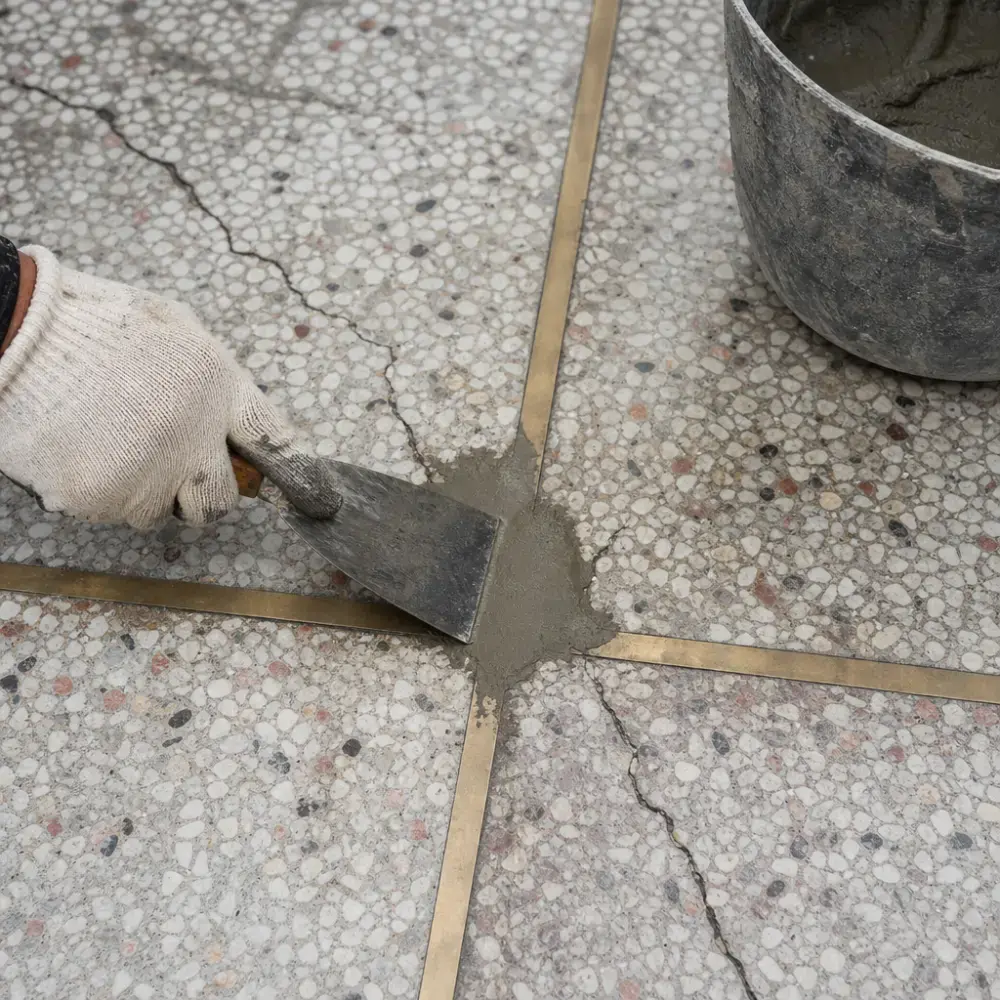
Terrazzo grinding and polishing in Houston runs $4 to $8 per square foot. It is the diamond work by itself, for a floor that is already exposed: dull from years of mopping, scratched by grit, etched by spills, stained on the surface, or left uneven by an old repair. If the floor is still under carpet or tile, the full job is on the restoration page.
The shine on a properly finished terrazzo floor is not a product. It is what marble chips and a dense cement matrix look like when they have been cut flat and then rubbed with finer and finer abrasive until there are no scratches left large enough to scatter light.
How the grinding goes
Metal-bond passes. The first passes use planetary grinders carrying diamond segments set in metal. Typical grits run from about 30 or 40 to 80. They are aggressive by design: they flatten lippage at divider strips, cut through adhesive residue and coatings, and take off the top skin of the floor where the scratches and shallow stains live. A floor with a stack of old acrylic or wax on it takes longer here, because coatings soften and load up the diamonds.
Repairs and grout. After the first cuts open the surface, pinholes and small voids show up that were invisible before. The NTMA restoration guide describes a grouting step: wet-grind with 50 grit or higher, remove the water, and grout with cement or epoxy to fill what is needed, then let the grout cure at least 12 hours. Larger patches go in at this stage too, so they are ground flush with everything else.
Resin-bond passes. Diamonds set in resin take over from around 100 grit and step up: 200, 400, 800, 1500, and as high as 3000 for a mirror finish. Each step removes the scratches of the step before. The NTMA guide lists the fine grind as 120 grit carborundum or 200 grit resin bond as the point at which the grout film is gone from the surface; everything past that is about how much reflection you want.
Densify and seal. A silicate densifier hardens the cement matrix, and a penetrating sealer goes on last. The NTMA’s sealer guide calls this approach honing combined with silicate-based penetrating sealers and notes that it leaves no sacrificial coating: when the floor scratches, the repair is to hone it again. That is the trade-off, and in a house it is the right one.
Picking a finish
| Finish | Stops around | Best for |
|---|---|---|
| Matte | 200 to 400 grit | Wet areas, back porches, patios under a roof |
| Satin | 400 to 800 grit | Most Houston living areas, kitchens, halls |
| High gloss | 1500 to 3000 grit | Formal entries and living rooms with light traffic |
Gloss is time. Every step above satin is another pass over every square foot, which is why a high-gloss floor lands higher in the $4 to $8 range. The cost calculator treats it as a multiplier for that reason.
Why not just buff it and coat it?
Because a coating is a different floor sitting on top of yours. The NTMA says wax or polishes on terrazzo are not only unnecessary but harmful, tending to create buildup and dull the finish. Acrylic “terrazzo shine” and urethane films look good for a while, then scratch in traffic lanes, yellow, and in a humid house can cloud as moisture works up from the slab. Getting them off later means grinding anyway. The coating buildup page shows what that looks like.
There is a place for film-forming finishes: commercial buildings with a janitorial program that strips and recoats on a schedule. The NTMA sealer guide covers both approaches fairly, and the commercial page explains when a removable finish makes sense. In a house, nobody wants that job.
Houston-specific things we watch for
Uneven floors. Clay under a Houston slab moves with wet and dry years. Where the slab has shifted, the terrazzo can be slightly out of plane across a crack or a strip. Metal-bond grinding can take out a small lip; it cannot flatten a slab that has dropped. If a section is significantly out of level, we will tell you before grinding, because chasing it with diamonds just thins the topping. More on the cracking page.
Thin toppings. A monolithic cement terrazzo topping is half an inch thick nominally, by the NTMA’s definition. A floor that has been aggressively ground before, or that was poured thin, has less to give. We look at an edge or a chipped spot before planning the passes.
Previously flooded floors. These are often the easiest to grind because the covering is already gone, but the slab may still be holding water. Grinding can go ahead; sealing waits for a moisture test. See flood-damaged terrazzo.
Dust in an occupied house. Water fed to the diamonds and HEPA vacuuming between passes are the floor-grinder controls in OSHA’s construction silica rule. Rooms are done in phases, and furniture moves with us.
Before you call
Mop the floor and take photos in daylight from a low angle, which shows scratches and dull lanes better than overhead light. Note anything you can feel with a fingernail: cracks with a lip, patches that sit proud, divider strips that catch a sock. Include the square footage. If you are not sure whether the floor needs only polishing or the full job, the pricing page and the dull and scratched floors page help sort it out.
Frequently Asked Questions
What is the difference between grinding, honing, and polishing terrazzo?
They are stages of the same process with finer and finer diamonds. Grinding uses coarse metal-bond diamonds to flatten the floor and remove glue, coatings, stains, and the worn surface. Honing uses resin-bond diamonds to remove the grinding scratches and close the surface. Polishing is the last few resin-bond steps that bring up reflection. Where you stop decides the finish.
How much does terrazzo polishing cost in Houston?
Grinding and polishing is $4 to $8 per square foot. A clean floor taken to a satin finish sits near the bottom. A floor with old coatings to cut through, large chips to level, or a request for high gloss sits near the top. Commercial floors run $4 to $10 per square foot depending on access and scheduling.
Should I pick matte, satin, or high gloss?
For most Houston houses, satin. It hides foot traffic and the fine scratches from grit tracked in from outside, and it looks right in a mid-century room. High gloss is beautiful in a formal entry or living room and needs more passes to get there. Matte is the choice for floors that get wet, and the 1953 Bendit House near Braeswood Place has its terrazzo continued onto the back terrace with a matte finish for exactly that reason.
Will polishing make terrazzo slippery?
The polish itself is not what decides it. The NTMA says the surface of natural terrazzo is not slippery and that slip resistance is dictated by the sealers and coatings selected. Water, soap film, and wax are what make a terrazzo floor slick, which is one more reason wax does not belong on it.
More terrazzo services
- Terrazzo Floor Restoration in Houston
- Terrazzo Crack and Hole Repair in Houston
- Carpet, Tile, and Glue Removal Over Terrazzo in Houston
- Terrazzo Stain and Rust Removal in Houston
- Terrazzo Sealing and Maintenance in Houston
- Commercial Terrazzo Restoration in Houston
- Flood-Damaged Terrazzo Restoration in Houston