 Houston Terrazzo Restoration
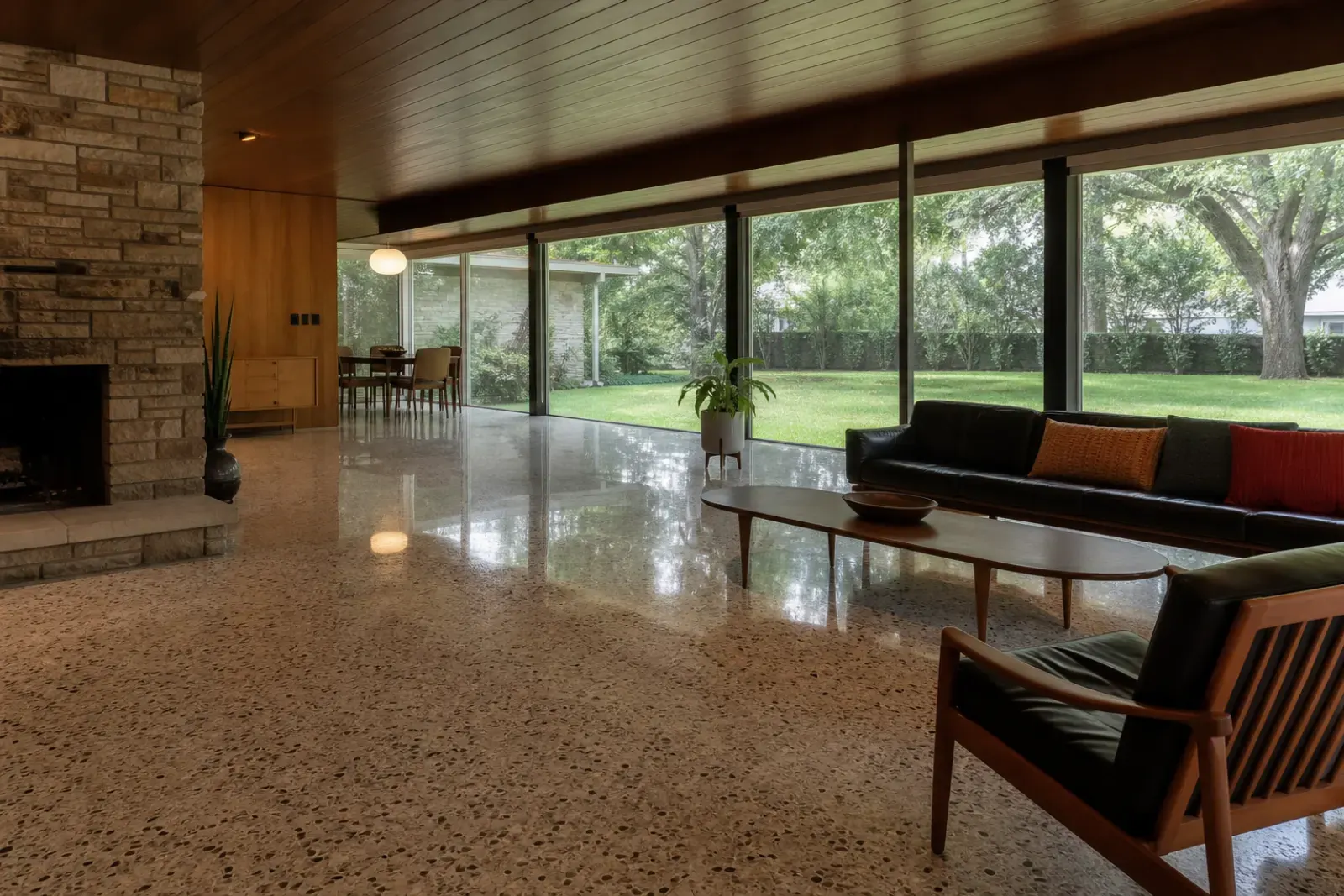
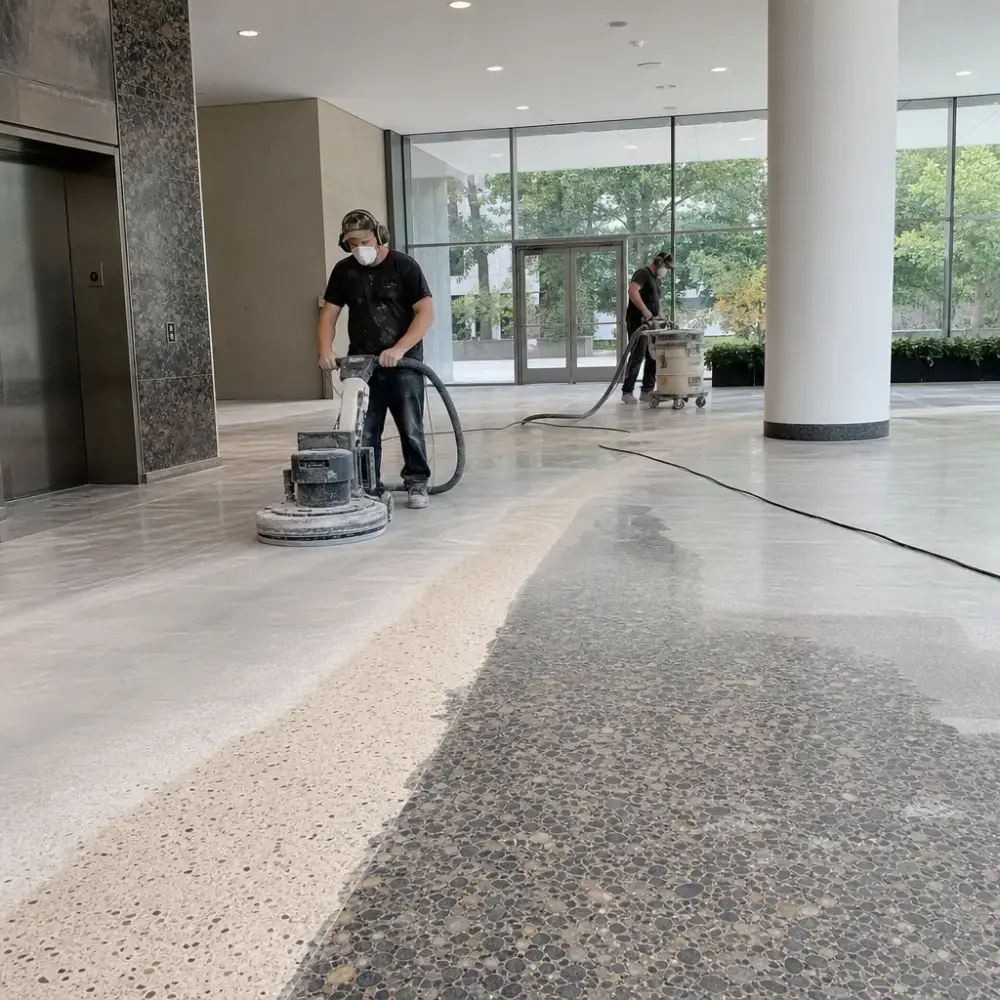
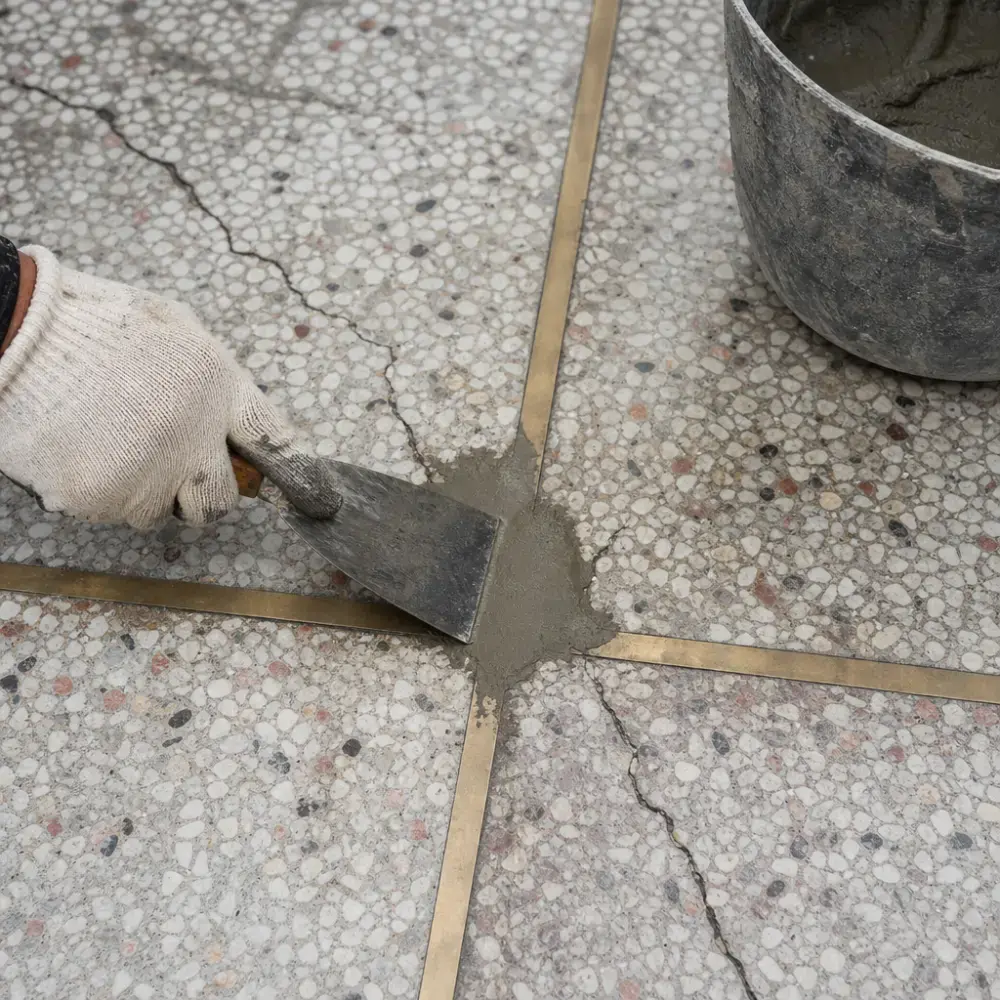
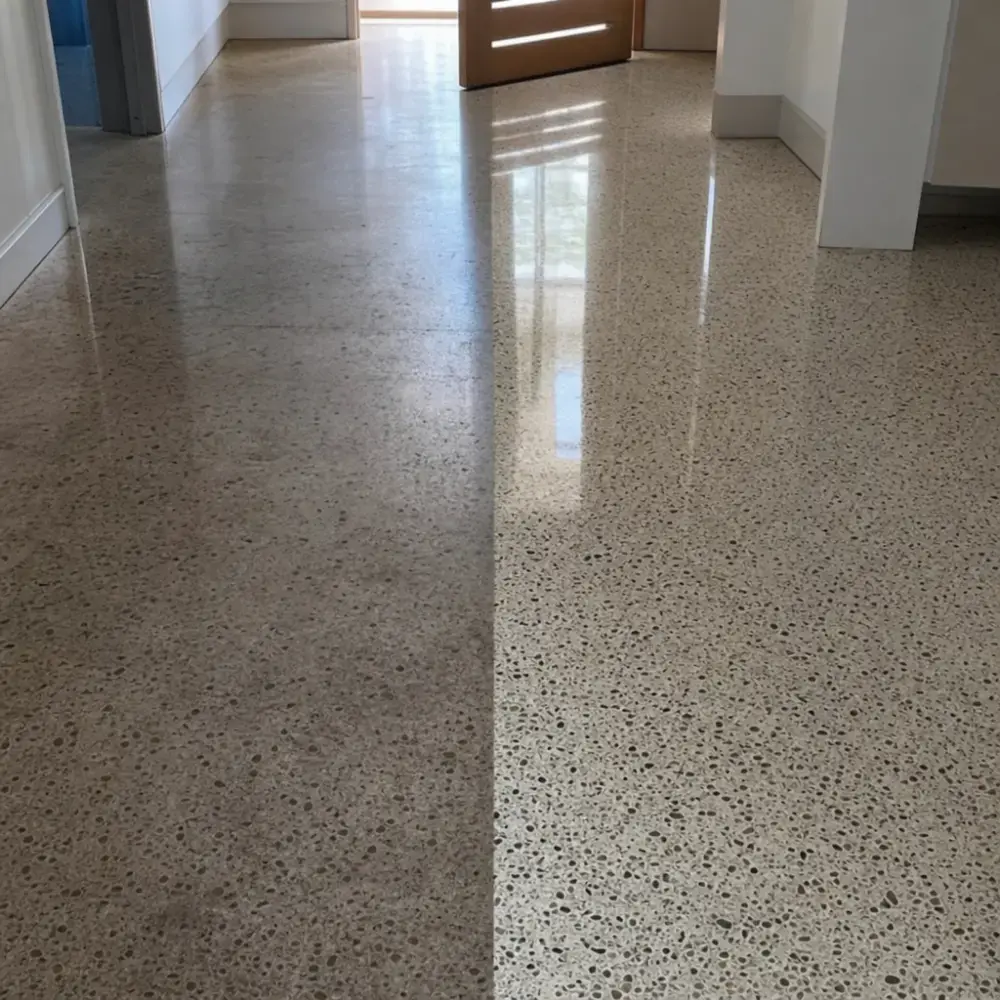
We restore original poured terrazzo in Houston houses and buildings: we grind it, repair it, polish it, and seal it, at $4 to $8 per square foot for the grind and polish. Taking carpet and glue off adds $1 to $3 per square foot, tile and thinset $3 to $6, and cracks and holes are $75 to $300 per patch. Most houses with 1,000 to 1,500 square feet of terrazzo come in between $4,000 and $12,000 before removal. A photo of the floor and a corner under the carpet is enough for a first number.
Houston has more terrazzo than people think. It went down in the 1950s and 1960s, when the city was building whole subdivisions at a time, and much of it disappeared under carpet, vinyl, and tile a generation later. The floods of the last decade pulled a lot of that carpet back off, and a lot of owners found out what they had while the wet carpet was going to the curb.
What we do
- Terrazzo restoration: the full job on a covered or tired floor. Covering off, repairs, grind, hone, polish, seal.
- Grinding and polishing: diamond work only, for a floor that is already exposed and just dull, scratched, or uneven.
- Crack and hole repair: cracks from slab movement, trenches cut for plumbing, holes from walls that moved, and the ring of tack-strip nail holes around every carpeted room.
- Carpet, tile, and glue removal: getting the floor back without chipping it, including thinset and the black adhesive under old tile.
- Stain and rust removal: rust from tack nails, dye from carpet pad, pet stains, and the tide lines a flood leaves behind.
- Sealing and maintenance: a penetrating sealer and a cleaning routine that does not involve wax.
- Commercial terrazzo: lobbies, schools, churches, and retail floors, ground and polished or put on a maintenance program.
- Flood-damaged terrazzo: the order of operations after water, from drying and testing to the final seal.
Where Houston’s terrazzo is
Houston’s postwar growth is the reason there is so much of it. In 1948 the city annexed enough unincorporated land to more than double its size, and by 1950 air conditioning was making the city a place companies wanted to move to. Builders answered with whole master-planned communities. The Houston Chronicle’s guide to the city’s mid-century houses describes them clustering in Sharpstown, Meyerland, and Westbury, built for the population boom of the 1950s and 1960s, and notes that some were finished with poured-in-place terrazzo floors.
What we know about specific neighborhoods:
- Meyerland: George Meyer turned 1,200 acres of rice fields into the subdivision in 1955. A Houston realtor writing on HAR.com about the old neighborhood remembers “rambling expanses of terrazzo” in its mid-century homes, and the 1959 Finger House there still has its poured terrazzo, matched seamlessly by the original installer when the house was added onto in 1974. See the Meyerland page.
- Braeswood Place: about 2,200 homes, most of them originally 1950s ranches. The 1953 Bendit House nearby, designed by Lars Bang, has terrazzo that runs from the front porch through the living room and out onto the back patio. More on the Braeswood Place page.
- Glenbrook Valley: about 1,250 houses built from 1953 to 1962 beside Sims Bayou, and in June 2011 the first historic district the city designated outside the 610 Loop. Houses there have been listed with their poured terrazzo as a selling point, including the 1957 house known as the Sputnik house and a home on Glenforest Court. See Glenbrook Valley.
- Memorial: Memorial Bend, first developed in 1955, holds the largest concentration of mid-century modern houses in Houston, and nearby in Huntleigh a 1959 house by Wilson, Morris, Crain & Anderson has terrazzo through most of the house. See Memorial.
- Sharpstown, Westbury, Bellaire, and Spring Branch: postwar tracts built in the same two decades, mostly slab-on-grade ranch houses. Not every house there got terrazzo, and a corner of carpet settles it. Start with the Sharpstown or Bellaire pages.
The same Chronicle guide also says where not to expect them: a Houston realtor quoted in it noted that Montrose and the Heights were going through a decline cycle in the 1950s and 1960s and “weren’t building mod palaces.” If your house is a 1920s bungalow, the floor is probably wood.
What Houston does to a terrazzo floor
Three local forces show up on almost every floor we look at.
Water. Houston gets about 50 inches of rain a year on flat ground with low-permeability clay soils, and the 2010s brought the Memorial Day flood of 2015, the Tax Day flood of 2016, and Hurricane Harvey in 2017. Harvey alone flooded an estimated 154,170 houses in Harris County, according to the National Trust for Historic Preservation, and submerged roughly a quarter of the county. Carpet, laminate, and engineered wood went to the curb. Terrazzo mostly stayed. What it needs afterward is time to dry, a moisture test, and a grind. The flood recovery guide walks through it.
Clay. The slab under a Houston house sits on expansive clay. The USDA’s official description of Lake Charles clay, an extensive soil of the Southeast Texas coastal prairie formed on Beaumont Formation sediments, records 45 to 60 percent clay and dry-season cracks half an inch to 2 inches wide that reach a foot or more down. When that clay dries and wets again, the slab moves a little, and a half-inch terrazzo topping bonded to the slab moves with it. That is where most of the cracks across Houston living rooms come from. The cracks page explains which ones matter.
Humidity. Houston summer mornings average over 90 percent relative humidity. A floor sealed with a film that traps moisture underneath will cloud and peel here faster than almost anywhere. A penetrating sealer that lets the slab breathe is the right choice for a house.
How the work goes
- Expose and look. Covering, tack strip, and adhesive come up. We check chip size and color, the matrix, cracks, any old coatings, and hollow spots before grinding anything. The NTMA’s restoration guide warns that conditions sometimes have to be re-evaluated once the floor is uncovered, and that is true of every floor that has been under tile.
- Repair. Holes and cracks are cleaned and filled. The NTMA guide calls for aggregate in the fill once a crack is wider than a quarter inch, and a sample patch so you can see the match before the room is done.
- Grind. Metal-bond diamonds flatten the floor and take off glue, stains, and the dead surface. Water on the cutting surface and HEPA vacuuming between passes keep the silica dust down, the controls OSHA’s construction silica rule lists for floor grinders.
- Hone and polish. Resin-bond diamonds step up through finer grits to matte, satin, or gloss.
- Seal. A penetrating sealer, with care instructions: dust mop, damp mop with clean water or a neutral cleaner, and no wax.
Typical prices
| Work | Typical Houston range |
|---|---|
| Grind and polish restoration | $4 to $8 per sq ft |
| Carpet, pad, and glue removal | $1 to $3 per sq ft |
| Tile and thinset removal | $3 to $6 per sq ft |
| Crack or hole repair | $75 to $300 per patch |
| Stain and rust treatment | $150 to $600 per area |
| Sealing an already restored floor | $1 to $2 per sq ft |
| Commercial hone and polish | $4 to $10 per sq ft |
| Minimum visit, one room or repair only | $750 to $1,200 |
The grind and polish rate sits inside HomeGuide’s average terrazzo restoration range of $3 to $8 per square foot and below the $8 to $18 that Angi’s stone restoration guide gives for terrazzo. The pricing page breaks down what moves a floor up or down, and the cost calculator gives you a range in under a minute.
Who should do the work
Texas does not issue a state general contractor license. State licensing covers specific trades such as electrical, plumbing, and air conditioning, and local permits cover the rest, so the words “terrazzo company” on a truck tell you very little. What you can check is method and equipment. Ask whether the floor will be ground with diamond tooling or just coated, what sealer goes on at the end, how the dust is controlled, and ask for a certificate of insurance. Ask us the same questions. If a stain on your floor will only lighten, we will tell you that before the work starts.
Questions first? The FAQ covers the usual ones, and about us explains how we work. Otherwise, send a photo of the floor, a close-up of the worst spot, and the rough square footage, and we will send back a range.